

The War Trade Softens, Altcoins Breathe, CPI Arrives Tomorrow
Tuesday, 10th of March Report


Trump’s “very complete, pretty much” signal handed bulls a session. Now comes the first inflation print since oil hit $120, and the answer matters a lot.
Markets opened Tuesday with the most constructive tone since the Iran strikes began. Bitcoin is trading near $69,400, back above the $69,000 level it lost last week, after President Trump told reporters Monday that U.S. military objectives in Iran were “pretty well complete” and the war could resolve “very soon.” Oil has retreated from Monday’s $119 spike to around $90 per barrel. Asian equities that cratered 7–8% on Monday surged 2–3.5% on Tuesday. Altcoins led: Solana is up 2.9%, ETH has reclaimed $2,000, and XRP is recovering toward $1.40. The institutional flow picture adds a constructive underpinning: CoinShares reported $619 million in crypto fund inflows for the week ending March 7, with $521 million going to Bitcoin products, all of it arriving during a week that saw the S&P 500 drop $1 trillion in a single session, per CoinDesk. But tomorrow morning at 8:30 AM ET, the February CPI lands (the first inflation read that captures the energy shock in real data) and the answer will define whether today’s recovery has legs or gets faded immediately.
1. Geopolitics: Trump’s Mixed Messages and What They Mean for Price
The presidential comments on Monday deserve careful parsing rather than face-value optimism. In a press conference, Trump said the U.S. has struck over 5,000 targets, that Tehran’s “two levels of leadership are gone,” and that objectives may be “pretty well complete.” Oil fell and risk assets rallied on that. But within hours, Trump told House Republicans that “we haven’t won enough” and that the most important targets had been deliberately held back “for later.” He also said he would waive certain oil-related sanctions to reduce prices, without specifying which ones.
Meanwhile, a top Iranian official told CNN that Tehran is “prepared for a long war” and sees “no room” for diplomacy, and top security official Ali Larijani posted publicly that Iran will not negotiate with the U.S. The two sides are publicly as far apart as at any point since the strikes began, per CNN. The March 4 peace signal that briefly sent Bitcoin to $73,777 collapsed when Iran’s Foreign Minister told NBC News that Iran had not asked for a ceasefire, per 247 Wall St.. Monday’s comments are less credible than March 4’s back-channel report, and the price accordingly moved less. The pattern is common: unverified optimism produces smaller, shorter bounces each time it fails to materialise into a ceasefire.
The diplomatic signal to trust is a joint statement from both parties, not a unilateral Trump press conference. Until that arrives, treat every geopolitical bounce as a trading event, not a trend change.
The structural observation from Nansen analysts is worth holding: crypto has “already absorbed the negatives and priced them in.” The 90-day correlation between Bitcoin and the S&P 500 has climbed to 0.78, one of the highest readings since mid-2022, meaning altcoins will amplify any equity move in either direction at the FOMC meeting next week.
2. Macro: The CPI Print That Could Reset Everything
Tomorrow’s February CPI release is the most consequential single data point of the month. The setup is genuinely difficult. Economists expect headline inflation to come in around 2.5%, slightly above January’s 2.4% reading, per CoinPedia. That baseline expectation alone would confirm inflation is re-accelerating, but February’s data was mostly collected before the Iran strikes on February 28. The energy shock that sent oil from roughly $70 to $119 in two weeks will not appear in full until March CPI, due in April. What tomorrow’s number captures is the underlying trend without the oil spike. If it prints above 2.5%, the Fed is under pressure even before the energy shock arrives in the data.
The prior print’s market reaction is the useful benchmark. When January CPI came in at 2.4% (a tenth below expectations) Bitcoin rallied 3.93% on the day, short liquidations accounted for roughly 85% of the $267 million flushed, and ETH and XRP followed cleanly higher. A repeat of that reaction requires a similar or softer-than-expected number tomorrow. A hot print (particularly a core reading above 2.6%) would undermine today’s recovery immediately and push rate-cut expectations out further. The CME FedWatch tool still has the March 18 Fed meeting priced at a 95% probability hold at 3.5%–3.75%. The CPI print will either confirm that or introduce the first serious uncertainty about the March meeting in weeks.
The oil complication is important to hold separately from tomorrow’s number. Even if February CPI prints in-line or soft, every analyst covering this space knows March CPI will be materially higher due to energy. The relief from a cool print tomorrow is therefore time-limited. As the KuCoin macro desk noted, persistent high or volatile oil prices could “distort inflation expectations, reinforcing the macro pressure narrative in crypto” regardless of what a single backward-looking CPI print shows.
3. On-Chain: Polkadot’s “Pi Day” Halving Is Three Days Away
While geopolitics and macro dominate the headline flow, a specific on-chain event on March 14 deserves attention as an independent catalyst: Polkadot’s first-ever issuance cut, dubbed the “Pi Day” halving inside the ecosystem. Following a community governance vote that passed with 81% approval (Referendum 1710), Polkadot will on March 14 hard-cap its total supply at 2.1 billion DOT and cut annual issuance from roughly 120 million tokens to approximately 55 million, reducing the inflation rate from 6.8% to 3.1%, per Tron Weekly. The unbonding period for staked DOT also drops from 28 days to 24–48 hours, materially improving liquidity for stakers.
The comparison to Bitcoin’s halving cycle is imperfect but not irrelevant. Both events reduce new supply entering the market, compressing the sell pressure from newly minted tokens. The difference is magnitude and precedent: Bitcoin halvings have four cycles of history and are priced in months in advance. Polkadot’s first issuance cut is structurally similar in mechanics but lacks the same anticipation infrastructure. The 21Shares TDOT ETF (the first U.S.-listed DOT exposure product) launched on Nasdaq on March 6, adding an institutional access channel that did not exist for previous Polkadot protocol milestones. DOT is currently down roughly 31% over the past 60 days, and the “buy the rumour, sell the news” dynamic applies. But the supply-side logic is real enough that DOT earns a scorecard slot this week, see the analyst note below.
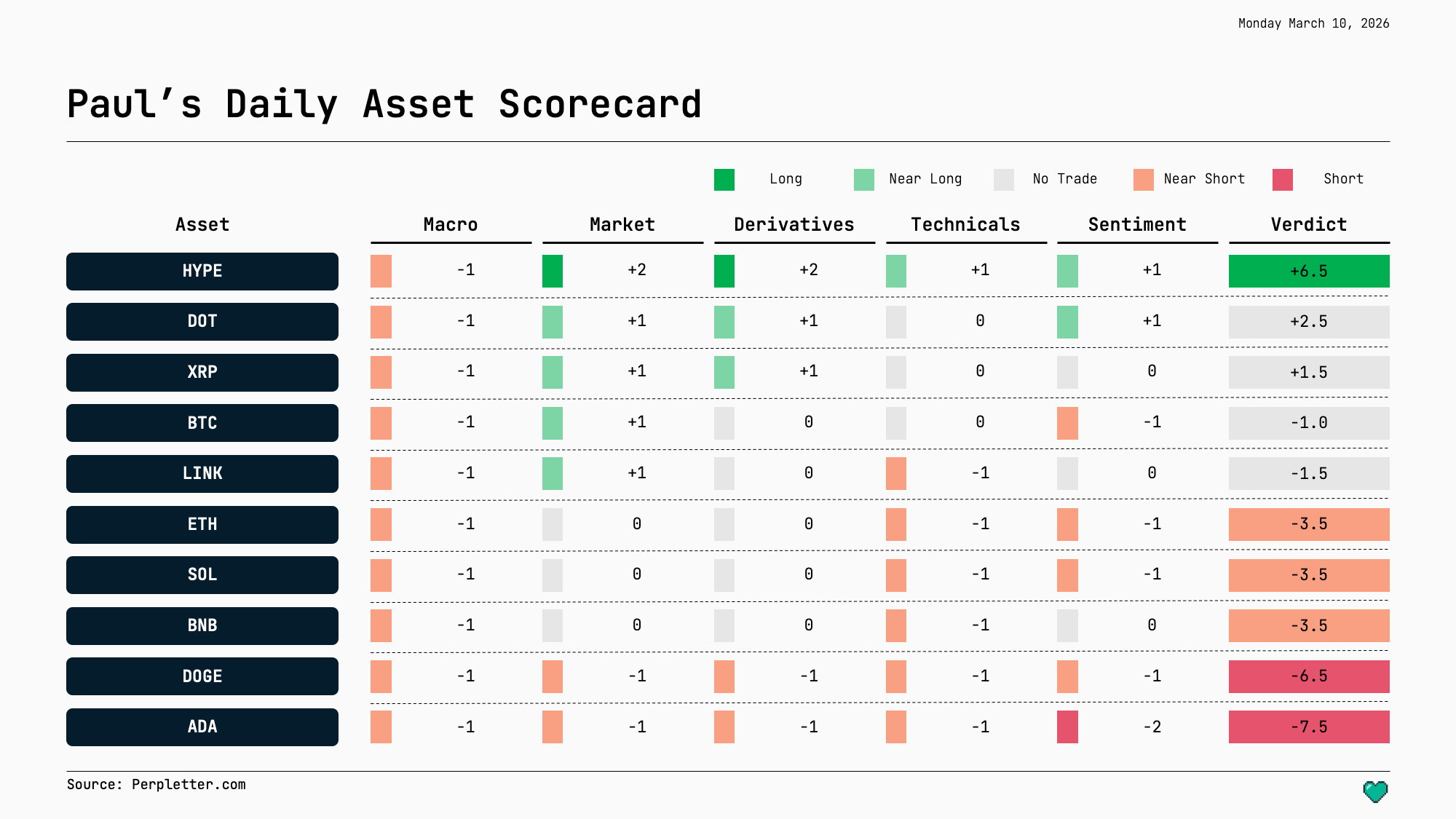
Daily Asset Scorecard
Weighted Score = L1 Macro ×2 + L2 Structure ×1.5 + L3 Derivatives ×2 + L4 Technicals ×1.5 + L5 Sentiment ×1 · Each layer −2 to +2 · Range −18 to +18
Tracked universe: BTC · ETH · SOL · XRP · BNB · LINK · DOGE · ADA · HYPE · TRX · DOT · AVAX · SUI · TON · UNI · WLD · TAO · LTC
BTC and ETH appear every edition. Rotating slots today: HYPE (Long thesis intact), XRP (OI recovery + ETF catalyst), DOT (Pi Day halving in 3 days — new entry), LINK (RWA thesis), SOL (Near Short, underperforming BTC), BNB (Near Short), DOGE (Short), ADA (Short). Assets reviewed and excluded: TRX (flat across all layers, no catalyst), AVAX, SUI, TON, LTC, WLD, TAO (no score change or active catalyst today).
HYPE · Hyperliquid · +6.5 · Long
Unchanged from Monday. The derivatives layer (+2) and structure (+2) readings are the strongest in the scorecard, validated by the platform’s continued role as the primary 24/7 pricing venue for oil during the Iran conflict. The macro headwind (−1) remains, but today’s oil pullback from $119 to ~$90 modestly reduces the risk-off pressure that could force a correlated sell-off. The thesis is intact and the platform’s utility proof-of-concept from the weekend is not reversible. Note that tomorrow’s CPI is a binary risk that could move the whole scorecard, and a hot print would push L1 further negative and compress the score toward No Trade territory.
DOT · Polkadot · +2.5 · No Trade (new entry — Pi Day halving catalyst)
DOT enters the scorecard this week on catalyst grounds. The Pi Day halving on March 14 (three days away) cuts annual issuance from 120 million to 55 million tokens and enacts a 2.1 billion hard supply cap, the first in Polkadot’s history. The structure layer (+1) reflects declining exchange reserves as holders move into self-custody ahead of the event, a pattern consistent with pre-halving accumulation behaviour. Derivatives (+1) show modestly positive funding and rising open interest, indicating capital entering rather than exiting. Sentiment (+1) is the most active positive layer: the Pi Day narrative has genuine momentum inside the ecosystem, and the recent TDOT ETF listing on Nasdaq has given the event institutional visibility it would not otherwise have had.
The macro headwind (L1: −1) keeps the score in No Trade territory, and that is the correct verdict. DOT at −31% over 60 days is not a clean setup, and the “buy the rumour, sell the news” dynamic after a well-flagged supply event is a real risk. The technical picture (L4: 0) is neutral; price has stabilised near $1.52 but has not reclaimed meaningful resistance. The actionable note: if the macro environment clears (specifically a soft CPI tomorrow and continued oil retreat) the catalyst alignment on March 14 could produce a short-term move worth having a position in. The level to watch is $1.99, which represents the first significant overhead resistance and the threshold that would confirm a technically constructive break.
BTC · Bitcoin · −1.0 · No Trade (score change: +2.0 from Monday’s −3.0)
BTC recovers to No Trade from Monday’s Near Short as the derivatives layer stabilises (L3: back to 0 from −1) and today’s price action reclaims the 50-day EMA. Funding rates normalised overnight from negative back toward neutral, removing the bearish derivatives signal that triggered Monday’s score deterioration. The structure layer (+1) holds, as long-term holder selling remains subdued and institutional ETF flows for the week were positive at $521 million into BTC products despite the macro shock. The technical layer (0) is neutral: price is above the 50-day EMA but below the 200-day, and $73,000–$74,000 remains untested overhead resistance. The No Trade verdict is correct: there is no high-conviction directional edge ahead of tomorrow’s CPI. BTC’s playbook is clear: soft print → push toward $72,000–$73,000; hot print → retest $65,000.
XRP · Ripple · +1.5 · No Trade (score change: +3.0 from Monday’s −1.5)
XRP’s derivatives layer improves to +1 as open interest hit its highest level since February 24, indicating capital returning to the asset. Combined with the structure layer (+1), the score moves back to No Trade from Monday’s −1.5. The fundamental backdrop is the same: Deutsche Bank, Aviva, and Société Générale all integrated Ripple infrastructure in February, the SEC ETF deadline on March 27 remains a binary catalyst, and the CLARITY Act provides medium-term tailwind. What keeps XRP from a Near Long verdict is the macro headwind (L1: −1) and the failure to hold any bounce above $1.45. A confirmed close above that level combined with a soft CPI tomorrow would push the score toward Near Long.
ETH · Ethereum · −3.5 · Near Short
ETH reclaims $2,000 today but the score stays Near Short, with the derivatives layer improving marginally (L3: 0 from −1) offset by a still-weak technical picture (L4: −1). The key observation is that ETH’s recovery today is weaker in percentage terms than SOL and XRP, consistent with structural underperformance noted since last week. ETH needs a sustained close above $2,100 (and ideally $2,200) to shift the technical layer positive and remove the Near Short verdict. Until then, bounces in ETH are macro-correlation trades rather than independent strength signals.
ADA · Cardano · −7.5 · Short
Unchanged. All five layers negative, no catalyst visible. Short verdict held.
DOGE · Dogecoin · −6.5 · Short
Unchanged. Four negative layers plus macro headwind. The only variable that could rescue this signal is an exogenous social media event, which is less likely in the current geopolitical climate than in a normal risk-on period. Short verdict held.
Sources
CoinDesk — Ether, Solana, XRP Jump Higher as Trump Signals Iran War Nearing End
CNN — Day 10 of Middle East Conflict: Trump’s Florida Press Conference on Iran War
CoinPedia — How Bitcoin, Ethereum and XRP Will React to This Week’s CPI Report
CryptoTicker — Crypto Market News: Bitcoin Price Battles $67k as US CPI and CLARITY Act Loom
Tron Weekly — Polkadot Sets 2.1 Billion DOT Cap in Economic Overhaul
Bitcoin Ethereum News — Polkadot Adopts 2.1B Cap; Issuance Cuts Begin Mar 2026
Euronews — Crypto’s 24/7 Platforms Dominated Iran War Trading When Markets Closed
AMBCrypto — Bitcoin Price Surges on CPI Relief — Yet BTC’s $70K Barrier Remains
Perpletter is published for informational purposes only and does not constitute investment advice. Do your own research.