

The World Is on Fire and Bitcoin Is Just Watching
Monday, 9th of March Report

Oil hit $118, Hormuz traffic collapsed, Asian equities cratered, and BTC barely moved. Today’s edition is about what that means, who got carried out, and why Hyperliquid is becoming the most interesting price discovery venue on Earth.
The weekend was catastrophic by any conventional macro measure. Iran appointed a new Supreme Leader. Israeli strikes escalated into Lebanon. Iranian missiles hit Saudi Arabia and Bahrain, killing two people near Riyadh and targeting energy infrastructure directly. Iraqi oil output dropped roughly 60% and tanker traffic through the Strait of Hormuz (through which roughly 20% of global petroleum supply passes daily) effectively collapsed, per CoinDesk. Brent crude surged as high as $119.50 a barrel in early trading, the biggest single-day oil move since April 2020, before pulling back toward $103 on reports that G7 finance ministers would discuss a coordinated emergency reserve release. Japan’s Nikkei fell more than 7%, South Korea’s KOSPI slid 8%, S&P 500 futures dropped 1.7%. And Bitcoin is trading at $67,300, down less than 1% on the day.
Here are today’s 3 stories.
1. Macro: The Stagflation Trap Tightens
The mechanics of this moment are worth spelling out precisely, because the combination is genuinely unusual. The U.S. economy shed 92,000 jobs in February (a significant labour market miss) which would normally shift the Federal Reserve toward easier policy. Easier policy means lower rates, a weaker dollar, and historically a tailwind for Bitcoin. But that transmission mechanism is blocked by oil. Brent above $100 is not just an energy story, it is an inflation story. Gasoline in the U.S. rose to $3.45 a gallon on Sunday, up 47 cents in a week, per AP via Yahoo Finance. Diesel hit $4.60, up 83 cents. Those prices feed into transport costs, manufacturing costs, and food distribution, which feeds into CPI, which the Fed is already watching above its 2% target at 3%.
The result is what economists call a stagflationary trap: slowing growth that should prompt cuts, paired with rising prices that prevent them. The CME FedWatch tool has a hold at the March 18 meeting priced at 97.3% certainty. Fed Governor Waller has said a transient oil spike may not change the calculus, but “if effects become more permanent” the outlook shifts. This is what “more permanent” starting to look like. Energy Secretary Chris Wright told CBS that price increases would be temporary, “weeks, not months.” President Trump posted on Truth Social that elevated oil prices are “a very small price to pay for U.S.A. and World Safety and Peace.” Markets are not yet sure whether to believe either of them.
The G7 coordinated reserve release, if it materialises, would be the first meaningful policy intervention to cool the oil shock. Watch the IEA call this week: it is the most important single event for crypto macro direction in the near term.
2. Geopolitics: Hyperliquid Becomes the World’s Weekend Trading Floor
Here is the detail that most crypto coverage is missing in favour of price charts: while the rest of the world’s commodity markets were closed over the weekend, Hyperliquid was open. Perpetual futures contracts on Hyperliquid tracking crude oil surged as much as 25% on Sunday, reaching $118 before pulling back to $102 on the G7 reserve reports, per CoinDesk. The platform’s CL-USDC contract hit $114.77 at the peak. Open interest on Hyperliquid’s oil contract reached $182 million with $823 million in 24-hour volume, not the scale of CME, but genuinely consequential price discovery happening in a venue that was inaccessible to traditional traders on a weekend.
The consequences for the wrong-way traders were severe. Nearly $40 million in liquidations hit Hyperliquid’s oil contracts on Sunday, with $36.9 million of that coming from short positions, traders who had bet on oil falling and got wiped out in a matter of hours, per CoinDesk. Across all of crypto, 94,058 traders were liquidated in 24 hours for total losses of $364.4 million, with long positions accounting for $215 million as the broader market sold off alongside oil. The single largest liquidation was a $6.88 million BTC-USD position on Hyperliquid.
Bloomberg captured the structural point: crypto markets are now “the only open window into how traders are pricing the continuing conflict.” The settlement mechanism, stablecoins like USDC rather than traditional clearing, is what enables 24/7 access. This is not a Bitcoin story. It is a financial infrastructure story, and Hyperliquid is at the centre of it. Kenny Chan, Coinbase’s head of Stablecoin Ecosystem, described the shift directly: for years, whenever a major geopolitical event hit over a weekend, Bitcoin was the only choice available to traders, it was 24/7 and occasionally uncorrelated. Now traders are going directly to the assets they actually want exposure to.
3. Markets: Is This 2022 or Something Different?
The comparison to 2022 is everywhere in analyst notes this week, and it is worth examining carefully rather than dismissing. In February 2022, Russia invaded Ukraine, Brent briefly hit $130, and Bitcoin eventually fell roughly 60% from its pre-war level. The parallel (oil shock, geopolitical escalation, risk-off cascade) is compelling. But analyst Tuur Krüger at NewsBTC makes a specific technical argument for why 2026 is different at the structural level: in 2022, the Federal Reserve was catastrophically behind the curve, with year-over-year inflation already running near 8% and the real Fed Funds rate at roughly, 7.5% when war broke out. The Fed was forced into the most aggressive hiking cycle in 40 years, and that policy shift (not the war itself) was the engine that drove risk assets down for most of 2022.
The 2026 backdrop is different. The Fed is not behind the curve in the same way: rates are at 3.5%–3.75%, not near zero. The oil shock adds inflation pressure, but it is a shock on top of a reasonably normal policy position rather than a shock on top of extreme monetary accommodation. Krüger’s rule of thumb: watch the long end of the yield curve. If the tenth futures contract starts repricing from its current roughly +12% toward +25%, markets are signalling the shock is becoming structural. As of this morning, that hasn’t happened. Long-term holders of Bitcoin (wallets holding for 365 days or more) have continued reducing their selling through March, with net position changes near the lowest levels since the drawdown began, per BeInCrypto. That is not capitulation behaviour. It is consolidation behaviour.
The counterargument, from CK Zheng at ZX Squared Capital, is equally specific: some Digital Asset Treasury companies — firms that hold Bitcoin on their balance sheets as a treasury asset — may be forced to sell to meet debt servicing obligations, creating a “vicious cycle” of forced liquidation that overrides the long-term holder picture. The total size of crypto ETFs and Digital Asset Treasury companies represents roughly 10% of the entire crypto market cap. If even a fraction of that is distressed, it matters.
4. Daily Asset Scorecard
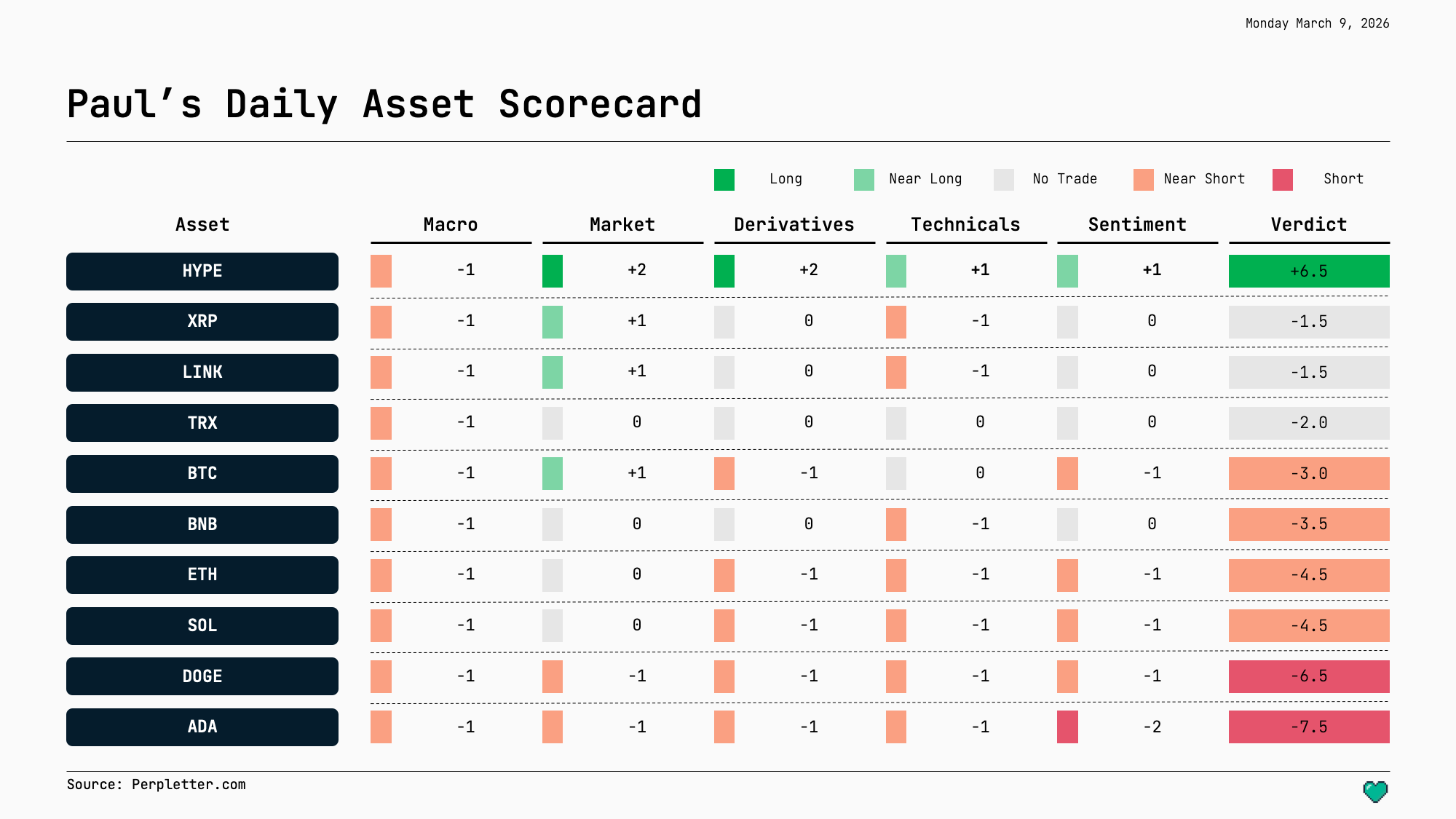
Weighted Score = L1 Macro ×2 + L2 Structure ×1.5 + L3 Derivatives ×2 + L4 Technicals ×1.5 + L5 Sentiment ×1 · Each layer −2 to +2 · Range −18 to +18
HYPE · Hyperliquid · +6.5 · Long
HYPE reclaims the Long signal today, and the weekend’s events are the direct reason why. The derivatives layer jumps to +2 (the strongest reading in the scorecard) because Hyperliquid is more than a crypto-native derivatives exchange: it is functioning as the world’s primary 24/7 pricing venue for oil, gold, and silver during a live geopolitical crisis. The $823 million in oil contract volume on Sunday, the $36.9 million in short liquidations, the $182 million in open interest, these go beyond speculative crypto numbers, they are real macro risk transfer happening through Hyperliquid’s infrastructure because nothing else was open. Platform fees, and by extension token value, compound directly from this volume.
The structural layer (+2) is unchanged and reinforced: every crisis event this month has driven new users and capital onto the platform rather than off it. Technicals (+1) recovered as HYPE held key support through the weekend sell-off, and sentiment (+1) is genuinely positive given the platform’s visible role in the crisis. The macro headwind (−1) is real and unavoidable, a broad market collapse would take HYPE down with everything else, but the fundamental thesis here is materially stronger than it was a week ago. The platform’s utility has been demonstrated in a live global shock in a way that no marketing spend could replicate. The main risk to size for is a targeted regulatory action against DeFi derivatives, which becomes modestly more plausible in a world where crypto is actively pricing wartime oil.
ADA · Cardano · −7.5 · Short
Unchanged from yesterday. All five layers negative, sentiment at −2. No catalyst visible. The Short verdict is held. See yesterday’s note for full composition.
DOGE · Dogecoin · −6.5 · Short
Unchanged from yesterday. Four negative layers plus macro headwind. The social media tail-risk caveat applies but is less meaningful in a market defined by geopolitical fear rather than retail exuberance.
BTC · Bitcoin · −3.0 · Near Short
A meaningful deterioration from yesterday’s −1.5 No Trade, driven by the derivatives layer worsening to −1. Funding rates on perpetual futures turned negative overnight — traders are now paying to be short, which historically reflects genuine bearish conviction rather than overcrowding on the long side. Combined with the macro headwind (−1), this is the first session where the score composition is uniformly directional rather than mixed. The structure layer (+1) remains the only green cell, held up by long-term holder behaviour and the continued institutional ETF presence. That structural support is real but it is not a timing signal, it is a floor estimate, not a near-term catalyst. The score sits at exactly the Near Short threshold. One further deterioration in technicals or another leg down in macro would push it to Short. The level that matters technically is $63,000–$65,000, a sustained close below that zone removes the last technical support argument for the bulls and would shift L4 to −1.
ETH · Ethereum · −4.5 · Near Short
Unchanged from yesterday. Price remains below $2,000, below the 50-day EMA, and ETF flows have been negative. The one development worth noting today: Ethereum is meaningfully underperforming Bitcoin on a relative basis this week, which is an additional bearish signal at the margin. When ETH cannot hold ground during a period where BTC is broadly flat, it reflects a weaker underlying bid structure.
BNB · BNB Chain · −3.5 · Near Short
BNB crosses into Near Short today, driven by the macro layer and a softening technical picture (L4: −1) as price breaks below the 50-day EMA. There is no BNB-specific catalyst — this is a market structure deterioration in a broadly risk-off environment. The score sits at the lower end of the Near Short band. Nothing here rises to the level of a conviction call. It is a directional lean only.
Sources
Bloomberg — Bitcoin Drops to 7-Day Low as Oil Price Spikes on Iran War Concerns
CoinDesk — Oil Shorts on Hyperliquid Get Wiped Out as Crude Surges 30%
CoinDesk — Oil Pulls Back from 25% Spike as G7 Discusses Coordinated Emergency Reserve Release
AP via Yahoo Finance — Crude Oil Prices Surpass $100 a Barrel as Iran War Impedes Production
Al Jazeera — Oil Soars Past $100 a Barrel, Stocks Plunge as US-Israel War on Iran Rages
FXStreet — Crypto and the Iran War: How Geopolitics Became the Market’s Biggest Variable
NewsBTC — Bitcoin Prints a 2022-Like Iran War Chart, But It’s Not
Bloomberg — Iran War: Oil, Gold, Silver Contract Spike on Crypto Market Hyperliquid
The Coin Republic — Fed Rate Cut Odds in March Hit Lowest Since US-Iran Tensions
DL News — Hyperliquid Captures Macro Trade as Bitcoin Hovers Near $65,000
Perpletter is published for informational purposes only and does not constitute investment advice. Do your own research.